Welcome to the Chic-Peas Kitchen!


We're two best friends, Kelly and Suanne, who love to cook! We have a passion for fresh food, complex flavors, and saving time. We'll share with you what's for dinner (really!) as well as how we made it and how we can make it better.

Jump in and learn with us!
Showing posts with label soup. Show all posts

Monday, November 25, 2013

Roasted Cauliflowe​r Soup

I am constantly craving soup as the temperatures drop and my grumpy-o-meter goes through the roof. Soup has this way of making you warm from the inside out. Any ingredient you have can be made into a tasty soup to warm your soup (and make me a bit less grumpy!)
 
Last night I had a few guests over and had to spontaneously menu plan. I spied some cauliflower on sale in the market - and cauliflower has been surprisingly expensive this year - so I snapped it up to make a creamy vegetable based soup. Roasting the cauliflower imparts a much warmer and round flavor while the roasted garlic adds a layer of pungent but gentle aroma. You can make the soup without the chicken broth or milk and it will still be hearty, smooth, and flavorful, and vegan friendly. Or you can be a bit decadent and add some heavy cream and bacon to the top for an added flavor boost and richness.


Pureed Roasted Cauliflower Soup
Serves 6-8
 

1 large head of cauliflower
Olive oil
Half head garlic
2 stalks celery
1 large onion
1 bay leaf
1 tablespoon dried rosemary
2 cups chicken stock
5 cups boiling water
1 cup whole milk (or half cup heavy cream)
Tablespoon salt
Teaspoon pepper
 
Optional: Bacon bits
 
 
  1. Preheat oven to 350 degrees
  2. Wash cauliflower and break into florets, around 2-3 inches large. Precision isn't key because you are going to puree the soup later.
  3. Line a tray with foil and add the cauliflower in a single layer. Drizzle with several tablespoons of olive oil and a sprinkling of salt. Mix to coat the cauliflower in oil.
  4. Take the half head of garlic and slice the top few millimeters from the top, exposing a cross section of the cloves. Drizzle olive oil into the cloves, wrap in foil and place seam side up in the cauliflower tray to roast.
  5. Optional: take a small broiling rack and position on top of the cauliflower. Lay three or four strips of bacon to cook and let the fat render over the cauliflower. Bacon can be diced later for bacon bits!
  6. Bake at 350 for 20 minutes, then stir to distribute heat and surface. Bake another 20 minutes or until golden on the edges.
  7. While roasting, dice the onion and celery.
  8. In a large stockpot, add the stock, water, bay leaf, celery, and onion to simmer. (I used my new crockpot! Hooray!)
  9. When cauliflower and garlic are fully roasted, add to stock pot and allow soup to simmer for a few hours.
  10. Before serving, fish out the bay leaf. Puree the soup mixture until smooth. Then add the milk or heavy cream. Salt and pepper to taste.
  11. Serve in bowls and top with a spoonful of bacon bits. I imagine sliced scallions, parsley, or fried garlic slices would also make excellent toppers!
     

Wednesday, January 2, 2013

Cabbage Kielbasa Soup


I never buy the same groceries. I always scour the window ads and browse the weekly circular to see what is on sale and menu plan based on my good finds. While I know this idea may not work for everyone, for most dishes I can plan ingredients and recipes on the go. Today's soup was born out of two purchases I never have on my radar: cabbage and kielbasa. (I channeled my secret Polish grandma that I never had.) The outcome was so tasty, I would definitely make it again.


Cabbage Kielbasa Soup


1 medium white onion
1 stalk celery
1 carrot
1 pound beef kielbasa
1 red pepper
4 cloves garlic
1 16 oz can crushed tomatoes
1 head green cabbage (about 3 pounds)


  1. Prepare the onion, celery, carrot, kielbasa, and red pepper by dicing them into 1/2 inch cubes. Mince the garlic. Core and cut the cabbage into ribbons (1/4 inch by 1 1/2 inches).
  2. In a 4 quart stock pot (or larger) heat 2 tablespoons olive oil. Sautè the kielbasa, onion, and garlic. When the onions have softened, add the celery, carrot, and red pepper. Sautè until soft.
  3. On the side, boil a quart of water.
  4. Add the can of tomatoes to the kielbasa and vegetable mix. Add the cabbage and boiling water to cover and reach the consistency you like.
  5. Simmer for about 30 minutes. Season liberally with salt and pepper. A bay leaf, basil, oregano, or a little chili would be good too.


Serves an army.

Wednesday, November 7, 2012

Escarole, Sausage, and Split Pea Stew

It is 35 degrees in New York. My toes are cold, my humidifier is on high, and I have more layers on than an onion. Which means that it is time for SOUP! I pretty much exclusively live off of soup in the winter months and I have made more soups than is probably normal for someone my age. But I digress, I love soup and here is another recipe.

Escarole is a leafy green vegetable. I was first introduced to it in lentil soup, Progresso to be precise, which I ate with slices of whole wheat toast as a winter after school snack. I rediscovered it in my local supermarket and it tends to be on sale often. Its a bit temperamental as a vegetable - if you cook it even a tiny bit too long, it acquires a bitter aftertaste. So the key to this recipe really is simple: add the escarole at the very last minute.

The following recipe is a meld of two foods I enjoy - lentil soup and yellow daal (an Indian pea soup). It has a lot of meatiness in the sausage and chicken broth and requires very little seasoning.

Escarole, Sausage, and Split Pea Stew
Serves four, about an hour

1/2 pound (1 cup) of dried split yellow peas
1/2 pound of sausage (I used breakfast sausage, but italian is good too)
1 large onion, diced
1 large carrot, cut into coins
4 cloves garlic, smashed
1 can low sodium chicken broth
1 cup water
1 bay leaf
1 teaspoon curry powder
1 head escarole, sliced into 1/4 inch ribbons, no longer than 2 inches
5 leaves lettuce (Optional: if you have a small head of escarole or want to mellow the flavor)


  1. Boil three cups of water. Soak the dried split peas
  2. Prep all vegetables and remove the sausage from the casing
  3. Heat a stockpot on medium. When hot, add the sausage, crumbling into small pieces.
  4. When the sausage is mostly cooked through, add the onion, carrots, and garlic. Saute until onion is cooked through.
  5. Drain the split peas and rinse.
  6. Add the chicken broth, water, bay leaf, curry, and the split peas. Cover and simmer for 20 minutes, until lentils are cooked through and are soft.
  7. Add the escarole and lettuce and stir to incorporate. Cook for about 3 minutes and serve with crusty bread. 
  8. Can be served as a hearty side, a chunky stew, or pureed with more water as a creamy soup.

Monday, April 30, 2012

Soon Dou Bu (Korean Tofu Stew)

I shouldn't have to prove to you my undying love for tofu or soup at this point. This dish is my go to Korean order and is typically served with seafood. What makes it delectable is the extra soft tofu, the poached egg,
and the spicy broth that makes your taste buds sing. My version is plainer and you can add your own protein or perhaps some radish or greens to make it your own. I've used seaweed to bolster my veggie stock but chicken broth is just as fantastic.


Soon Dou Bu (Korean Tofu Stew)
Serves 6

1 1/2 cups rehydrated seaweed sliced into ribbons
3 ribs celery, sliced thinly
6 cloves garlic
4 coins ginger
1/4 napa cabbage, sliced into ribbons
1 carrot, in coins
1.5 tbsp spicy red pepper paste
2 tubes extra soft tofu
Salt and pepper to taste
1 egg per person (get the freshest eggs for poached)

Topping:
2 scallions, chopped
1 tbsp sesame seeds
1 tsp sesame oil


  1. Boil a pot of water. Use a cup of the boiled water to hydrate the seaweed (reserve the excess water for the stock, but strain first through a paper towel.)
  2. Meanwhile prep all veggies as specified.
  3. In a large pot, heat a teaspoon of olive or vegetable oil. Turn the heat to medium low and add ginger. Add the garlic and the red pepper paste and heat until fragrant.
  4. Add the vegetables and sweat for 5 minutes until softened.
  5. Add the boiling water to cover, then add the tofu. Simmer for 15- 30 min.
  6. For the topping, mix all ingredients into a small bowl.
  7. To serve, scoop the stew into a bowl. Crack the egg into the center, top with scallions and sesame, and wait a minute before enjoying. Serve a bowl of white rice on the side.

Monday, April 16, 2012

Paprika Corn Soup

In search for a summer soup that would be filling, with lots of veggies, and good hot or just a bit warm, I came across multiple recipes using corn. I liked cream corn soup as a kid, but I'll admit that the price of fresh corn in the city was too expensive and that frozen corn just isn't the same. In a soup though, I would be able to use frozen without compromising too much, since I could beef up the flavor with other ingredients.


Paprika Corn Soup
Serves 6

1 large onion
1 large carrot
3 stalks celery
2 tomatoes
1 jalapeno (flesh, no ribs or seeds)
1 can of beer
5 cloves garlic
1 bay leaf
1/2 teaspoon cumin
32 oz bag of frozen corn
2 teaspoons paprika
1 tablespoon salt

  1. Heat a medium pot with 8 cups of water. Set to boil. 
  2. Rough chop the onion, carrot, celery, tomatoes, jalapeno, and garlic. Heat a large stock pot with a tablespoon of olive oil and saute until tender.
  3. Add the bay leaf and beer. Saute until alcohol evaporates (10 minutes).
  4. Add the boiling water and simmer for about 30 minutes.
  5. Add the cumin, paprika, and 30 oz of frozen corn (reserve some to finish the dish). Bring back to a simmer.
  6. Pull out the bay leaf and discard. Fire up the immersion blender.
  7. Add the reserved corn, add salt to taste, and serve. 
  8. If you want the soup to be a little richer, add a teaspoon more of olive oil or a dollop of sour cream.

Wednesday, February 29, 2012

Butternut Squash Soup


I like happy colors in the winter just as much as I like a hot meal. Combine both of these likes to make a soup I love!! Unlike the versions in restaurants, I omit the heavy cream or cream cheese to make a lighter vegan  version that is more savory and less like pie filling.

Butternut Squash Soup
2 medium white onions
3 ribs celery
2 carrots
3 coins ginger
1/2 butternut squash
1/2 calabeza squash (or pumpkin, acorn, kabocha, etc)
1 tablespoon brown sugar
pinch of cayenne
Salt to taste
Optional: 1 sweet potato

  1. Turn your oven to 375 with the rack in the middle.
  2. Scoop out the seeds and "guts" of the squash. Place cut side down on an aluminum foil covered sheet pan. If you're including sweet potato, roast it with the squash.
  3. Bake for 1 hour until fork tender.
  4. Cool until it can be handled.
  5. While the squash is roasting, prepare the vegetable stock. In a large pot, saute onions in a little olive oil. When transparent, add celery, carrots, and ginger.
  6. Add water to cover and simmer for about an hour.
  7. Scoop cooled squash into the vegetable stock using a spoon.
  8. Using an immersion blender, puree the whole pot together. Serve hot or cold with a handful of pumpkin seeds and a sprinkle of cinnamon.

Monday, February 27, 2012

Pork Congee (Jook or Rice Porridge)

While chicken soup is the American sick kid meal of choice, mine happens to be congee, a Chinese rice porridge. I actually used to hate congee, known as jook in my house. It can be bland, watery, and fickle when reheating. But as my mom continued to perfect her recipe and we added a multitude of ingredients, jook has become one of my favorite comfort foods. Its filling and hearty, without being heavy. Its hot and replenishes you with fluids in an easy to digest dish. And best of all, its very easy to customize to your tastes.

My house always begins with making stock. I favor pork stock because its easier to make and there are less hazards from small bones. Making chicken stock requires straining and its easier to have stringy meat, although the flavor is cleaner. Feel free to use canned broth and skip steps 1-5.


1.5 pounds pork bones (my super market carries neck, mom gets the spine - anything goes)
1 onion, small diced
1 rib celery, small diced
3 thick coins ginger
3 cloves garlic, slightly smashed
1.5 cups dry rice
6-8 mushrooms, sliced

Topping (per serving):
1/2 scallions, sliced thinly
1 teaspoon sesame seeds
  1. Take a large pot and heat on high for a minute.
  2. Sear the pork bones until browned on all sides.
  3. Turn the heat to medium. Add in the chopped onion, celery,  ginger, and garlic. Scrape the brown bits from the bottom of the pot. (If it seems too difficult, add in a tablespoon or two of rice wine or water.
  4. When the onions are translucent and cooked through, add water to cover the contents of the pot. Turn heat to low and let it simmer for an hour.
  5. 30 min before dinner, uncover the pot and check the water level. Add more to cover the contents of the stock.
  6. Optional step: Remove the pork bones. And separate the meat. From the bones. Put the meat into a bowl and shred. Discard bones.
  7. Add the uncooked rice and stir. Let the pot simmer, covered for 30 minutes, stirring every 5 minutes. At the end, as the rice is cooked and the rice begins to break into smaller grains, you will need to stir more often
  8. because the bottom will stick. I like my congee thick, about oatmeal consistency. If you like it thinner, you can always cook shorter or add more water.
  9. Serve topped with scallions and sesame seeds.

Tuesday, November 29, 2011

Masala Broccoli Potato and Lentil Soup

Soup, I love thee - let me count the ways:
  • You're warm and comforting
  • You're ridiculously easy to make
  • You take me (and my ingredients) as we are, and don't require fancy things
  • You usually are very considerate of my waistline

Today's soup was born out of a splendid buy at the Chinese supermarket, which offers quick sales. That is, certain items are discounted due to being overripe, bruised, etc, for cheap and fast consumption. Usually that means I get a lot of one thing that needs to be cooked ASAP but will last me a week, like my garlic eggplant. This time it was 5 crowns of broccoli!


This soup is vegetarian and can easily be made vegan. It has a great savory undertone from the spices, but they're not overwhelming - its just enough to give the soup a je ne sais quoi.

Masala Broccoli Potato and Lentil Soup
6 servings, about 1 hour for all prep

1 onion
6 cloves garlic
1 tbsp tomato paste
1/2 tsp curry
1 tsp garam masala
1 tsp black pepper
4 crowns broccoli (you can use stems too, just peel off the tough outer
layer at the bottom)
4 medium potatoes
3 ribs celery
2 carrots
6 leaves napa cabbage (I had it on hand and it had to go!)
1 tbsp salt
1 1/2 cup milk (again, had to go)

  1. Prep all ingredients by chopping them all into rough 1 inch cubes. Garlic should be minced.
  2. In a smaller pot, fill with 4-6 cups water and set to boil.
  3. Heat a large pot on the stove. Add 1 tablespoon olive oil. Since there is next to no fat in the ingredients, you can be liberal with the olive oil.
  4. Saute the onions until translucent. Lower heat to medium low, then add the garlic, curry, masala, and tomato paste. Roast until fragrant.
  5. Add potatoes and celery to the onions and garlic, tossing them to incorporate with the spiced olive oil. If the pan becomes too dry, add 1/2 cup of the hot water you have set to boil.
  6. Add remaining vegetables and 1/2 cup hot water. Cover and steam/simmer for 10 minutes, until broccoli is tender.
  7. Add the milk and remaining hot water to just barely cover the vegetables. 
  8. Add salt to taste.
  9. Serve as is with chunks or use an immersion blender to puree. Serve with crusty bread.

Monday, September 12, 2011

Tomato Stew

Tomato Stew with Shrimp
Serves 4

3 tbsp olive oil
1 red onion, diced
4 cloves garlic, roughly chopped
16 oz can pureed tomatoes
1 cup collard greens, sliced in ribbons
1 red and 1 green bell pepper, diced
1/2 tsp red chili flakes
1 tsp basil
1.5 tsp oregano
1 tbsp sugar
1 tsp pepper
1 tsp salt (or to taste)
5 frozen pre-cooked shrimp per person
Cilantro, fresh basil, parmesan, or mozzarella to top

  1. Prep onion and garlic as directed.
  2. Heat a pot over medium heat with the olive oil. When hot, add onion and garlic. Sautee until onion is translucent.
  3. Pour in tomatoes and reduce heat to medium low. Then prep other ingredients while tomato puree begins to reduce.
  4. Add all other vegetables and seasonings. Cover and simmer for 20 min. (In the meantime, you can make some pasta or rice to serve your stew with).
  5. Add the shrimp and stir into stew. Cook for an additional 5 minutes.
  6. Serve immediately.

Tips:
  • Shrimp does not need to cook long. Shrimp should be added for the portion meant too be eaten today and not saved for tomorrow!
  • Cut acidity by adding more sugar or olive oil.
  • Would be great with a spicy sausage rather than shrimp, which should be cooked at the beginning with the onion.

Sunday, January 30, 2011

Clam and Cabbage Soup

Chinese people have a communal meal called "huo guo" (hot pot) or "dai been loh" which is basically a lot of people sitting around a soup pot. The take turns tossing things in and taking them out and trying them with various sauces. Its not very exciting culinary-wise, but its very satisfying socially.

Today's dinner was borne of a conversation about hot pot. I was nostalgic and wanted to make my own hot pot for one (with maybe some leftovers).


Clam and Cabbage soup
Serves one

5 live clams (I love clams, I bought manila today)
6 leaves napa cabbage (its light green and oval in shape. Sweet and soft in soup. Bok choy is also great)
1/2 cup chicken broth
1 generous coin ginger
1 clove garlic smashed
1 pinch red chili pepper flakes
1 scallion, sliced thinly in coins (cilantro or parsley are also great)
Optional:
1 serving noodles (egg noodles for me but vermicelli is great for this!)
3 ounces cubed tofu for extra meatiness
Spinach or watercress if you want extra green

  1. 30 minutes in advance, brush the clam shells under running water to remove sand. Then soak the clams in cold water to allow the clams to open up and you to get any extra sand out of the inside.
  2. Meanwhile, take out two pots - one for the soup, and one to just steam the clams. (The clam pot should be wider rather than tall as we want the clams to sit in a single layer.) Place the chicken broth in one and bring to a simmer as you prep other ingredients.
  3. Wash and chop your napa into 1 inch slices, cut the coin of ginger, smash the garlic, and slice the scallion.
  4. Toss in the garlic and the napa into the pot and let it all simmer.
  5. Take the other pot and toss in 1/2 a cup of water. (Personally I'm using beer, you can also use white wine). Add the garlic and red chili and bring to a simmer. Place the clams in a single layer and cover.
  6. Come back in 2 minutes and see if they have opened. If not, cover and give it another minute. If the clams don't open on their own, don't force it open - it may be dead and full of sand!!
  7. Shake the clams in the remaining water/alcohol to remove any remaining sand. Transfer the open clams to the soup pot. Take the residual clam brine and pour through a coffee filter into another bowl. Add as desired to soup stock. (I promise its delish!)
  8. Top with scallion, add salt and pepper as desired. Serve.

Monday, January 3, 2011

Spinach Egg Drop Soup

Greetings food friends!

I recently made a giant pot of chicken stock, and you know what that means! Soup. Lots and lots of soup!

Today's soup takes one of my favorite brunch foods and turns into into a flavorful, yet light soup. Other than the requisite chicken stock, it also uses bacon to give the broth some OOMPH!


Spinach Egg Drop Soup
Makes two cups. Serves one really hungry Suanne. 20 minutes


1 tablespoon diced bacon (mine was frozen)
1 clove garlic, smashed
1 1/2 cups frozen chopped spinach
1/4 cup sliced leeks (optional. Added because I had them around)
3/4 cup chicken stock
water
2 eggs, beaten
 salt, to taste

  1. Take a non-stick soup pot and place on high heat. If your pan needs it, add a teaspoon of oil - mine is stainless steel so I didn't bother
  2. When hot, toss in bacon and cook until fat is rendered and you get yummy brown bits on the bottom of the pan.
  3. Add garlic and leeks (or other fresh veggies) and cook for a minute until mostly cooked through. Make sure to take the opportunity to scrape off the brown bacon bits.
  4. Add frozen spinach and chicken stock. If you have chicken parts/veggies in your chicken stock, feel free to add it too.
  5. Add enough water to cover, which should bring the liquid level to 2 cups (my pot has it conveniently labeled on the side.)
  6. Bring the soup up to a low boil. Push the solid contents of the soup to the middle. Pour the egg, tablespoon by tablespoon into the boiling stock. The trick to egg drop soup is to pour slowly into hot water so the egg cooks quickly. Don't stir immediately, wait 20 seconds before drawing your ladle around.
  7. Salt to taste. Enjoy!

Friday, October 1, 2010

Chicken Stew

When it gets cold, nothing makes me happier than hot food. Now you've seen my Chicken Stock and Tofu Stew, but I wanted to make something a little more traditional and Americana this time. Hence, Chicken Stew!


Chicken Stew (6-8 servings)
leftover chicken bones in your freezer (I had about 3 sandwich bags full)
3 chicken thighs/drums, skinless, and with the meat scored (aka cut parallel lines to the bone. Helps you to tear the meat off into edible chunks later)
1 large carrot, rough chopped (bite size chunks)
4 stalks celery (bite sized)
2 medium potatoes (bite sized)
1 onion, diced
2 garlic cloves
1 large bay leaf
6 cups boiling water
pepper
salt
oregano
cumin

  1.  Heat a large pot. Add olive oil and swirl to coat the bottom.
  2. Add the chicken bones and sear. When you start seeing "brown bits" on the bottom, deglaze with a few spoons of beer or wine.
  3. Add the chicken thighs and drums. Sear. Flip over and sear the other side. When things start to stick, add more beer and/or start adding onion.
  4. When the chicken is fully cooked on the outside, add all the vegetables. Celery leaves included. Scrape all the brown bits from the bottom of the pan. Add a teaspoon of salt, pepper, oregano, the garlic, bay leaves, and a pinch of cumin.
  5. Slowly pour in the boiling water. The water shouldn't be enough to cover all your ingredients - you're making stew, not soup.
  6. Bring back to a boil, then to a simmer. Monitor for 10 minutes and skim the scum from the top.
  7. Let simmer for 2-3 hours. Taste test for salt and how thick you would like the stew to be. As the veggies cook, they will thicken the soup.
  8. Grab your trusty chopsticks. Fish out all the bones and the bay leaves and discard. After two hours, the meat should fall right off the bone into shreds. 
  9. If your soup is not thick enough, mix a teaspoon of cornstarch with a tablespoon of water. Stir slowly into the soup stock.
  10. Serve! Great with crusty bread OR...


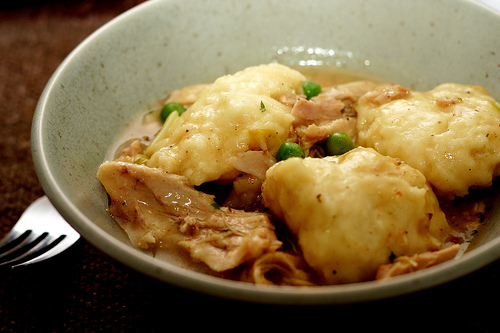
Chicken and Dumplings (aka day 2 of chicken stew)
for one serving

One pint Chicken Stew
1 teaspoon butter, melted
1/3 cup flour
1/6 cup milk
1/2 teaspoon baking powder
pinch of salt
pinch of oregano and/or basil flakes

  1. Reheat the chicken stew on medium heat. Check and see if there is enough liquid to create the consistency you like. I usually have to add a quarter cup of milk. Bring to a simmer
  2. Meanwhile, melt the butter in a bowl. 
  3. Add the flour, milk, baking powder, salt, and herbs
  4. Incorporate into a batter - should be goopy
  5. When the stew is simmering, give it a quick stir. Drop the batter into the stew one heaping teaspoon at a time. DO NOT STIR. Let the dumplings sit on top of the stew. 
  6. Cover the pot and let it simmer for 15 minutes. The steam of the stew will cook the dumplings.
  7. The dumplings are done when you insert a toothpick and it comes out clean. Carefully spoon out the stew and dumplings and enjoy!

Monday, March 1, 2010

Tofu Stew

It was a cold day in New York. The wind whistled around corners and down alleys, chilling everything to the bone. After hours of frozen fingers and florescent lighting, there was only one hope:

Tofu Stew. Something so hearty, so full of stuff, so hot - it works miracles.

Yesterday we left our heroine with a big pot of chicken stock. What that really amounted to was 3 servings of pure chicken stock (as in clear, and with no stuff, about 1.5 cups each) and 3 servings of "stuff." In my opinion, the "stuff" is the best. Its all the leftover meat from the bones, the veggies, and the junk at the bottom of my hard work in a pot. The stock went in the freezer, the "stuff" to the fridge (if you freeze it, the veggies will only get mushier). Today's tofu stew uses 1.5 cups of "stuff."


Tofu Stew - 1 serving, 1.5 bowls

1.5 cups of "stuff" which is mostly the soup veggies and chicken meat, with just enough broth to cover it.
1/3 block of silken tofu (I'm a big fan of silken. I told my boyfriend if he didn't like silken, we can't get married, that's how much I love it)
2 leaves napa cabbage
3 button mushrooms
1/2 teaspoon of salt
dash of pepper

  1. Heat up your "stuff" in a soup pot.
  2. Slice open the tofu package. There will be a lot of water in the package, so do this by the sink. Pour some of the water out and spoon out the tofu into the soup. (Doesn't need to look pretty). Leave the rest of the water, so the remaining tofu stays moist. If you don't, you get firm tofu :(
  3. Cut the cabbage into inch long slices horizontally. Slice the mushrooms.
  4. When the tofu and stuff is simmering happily, toss in the sliced veggies - these only need about 3-5 minutes to cook. Add more water if it isn't enough to cover everything in the pot.
  5. Taste test! Add salt and pepper as needed. Tofu and veggies do exude a lot of water as well as absorb all the seasonings in the "stuff" so you will need more!
  6. Enjoy!

Simple Chicken and Veggie Stock (Homemade Chicken Broth)

I bought a giant family pack of chicken thighs on Friday, anticipating that I'll be cooking next week. I buy family packs and divide the meat once I buy it into single serving portions. The majority gets deboned, skinned, diced, and into little sandwich baggies for the freezer. (all labeled neatly with the date of course) Its not a clean job, but that one hour of prepping the chicken saves me a lot of time come Tuesday night when I hate my job, my life, and all I want is stir fry and a pillow.

Like my mom (the master of penny pinching), I save the thigh bones in a nice big quart sized freezer bag. When the bag is full, I make chicken stock! Now homemade chicken stock is awesome for a few reasons: you save money, you can save the stock into the portions you need, and you can tailor the stock just how you like it! Personally, canned broth tends to be too salty for me and I actually only want half the can. Which means, I pour in a quarter of  a can, then a quarter cup of water, and then have to figure out how to save the rest. :-P I like my broth a little less concentrated, not too salty, and with a good round veggie flavor.


Homemade Chicken Stock

Olive oil
1 quart bag of chicken bones (no skin, remove as much fat as you can, defrosted!! Having leftover meat on the bones is cool.)
3 cloves garlic
2 coins of ginger root
1 big carrot
2 ribs celery
1 onion
1 parsnip (optional)
1 bay leaf (sorta optional)
salt, pepper to taste

The process:
  1. Large dice the veggies (mirepoix, as the French say. Smash the garlic cloves with the back of your knife and cut two coins of ginger root, about a millimeter thick. This stuff doesn't need to be pretty, so no pressure to be exact about keeping things the same size.
  2. Get a large stock pot (say 4 quarts?). Put it on the burner on high heat, add a tablespoon of olive oil, and let the pan heat up first for about 30 seconds.
  3. Dump the chicken bones in. You're looking to sear/brown the bones. Sounds unnecessary, but definitely gives your stock a better flavor. The brown bits will stick to the bottom of the pan. Brown bits = yummy.
  4. Dump in your onions, garlic and ginger and turn the heat down to medium high. Mix them around with your trusty wooden spoon and scrape the bottom of the pan to "deglaze" the brown bits. The water in the onions will help the brown bits come off.
  5. Add the celery, carrots, and parsnip. Make sure you've gotten as much of the brown bits off as you can.
  6. Add water and the bay leaves. Add enough to cover the bone/veggie mix and then some. For me this ended up being 3.5 quarts. Don't fill to the absolute top of the pot or once it boils you have a mess.
  7. Leave it alone for a bit (a good time to clean up). When the pot starts to simmer, turn it down so it stays at a simmer and does not boil. About 20 minutes in, you'll start seeing a lot of gray scum float to the top of the stock. Its totally normal. Start skimming off the scum with your ladle, being careful not to get too much stock with it. (This is a skill you'll have to practice). Dump the scum down the sink and run some hot water after it. As the stock continues to simmer, check back every 20 minutes or so, skimming more scum off each time. Eventually you'll get it most of it.If you don't get rid of the scum or accidentally let the stock boil in the scum, you get cloudy chicken broth. It won't kill you, but it looks pretty gross.


  8. After you get most of the scum (say an hour after you add the water?) add the pepper and salt. I used about 2 teaspoons of salt and a teaspoon of pepper for my 3 quarts. Let the pot simmer for about three hours. The longer the better really. I let mine sit overnight. Taste it periodically and see how you're doing. 
  9. Drain! I usually spoon just plain broth into ziplocs. As I get to the bottom of the pot and its hard to navigate around all the goodness on the bottom, grab a sieve and another pot or pitcher and drain the whole thing. While there's not much left to do with the bones, I personally love the veggies and I'll eat them right up. The chicken veggie mix is perfect to take it one step further for chicken soup, when you just add in a handful of rice or noodles and diced chicken.

How to store it:
ice cube trays
Ziploc sandwich sized bags (store it upright, lined up in a container. Break off pieces as needed.)

What to do with it: soup, flavoring veggies or rice, deglazing pans, making sauces.

Followers